
Choosing a top data management vendor can be a challenge. To successfully outsource data management services, you need a provider with the right skillset, track record, and security certifications. Given the importance of data, the best data management fit depends on how well a vendor understands your needs and how meticulous their approach to compliance is.
Another issue is that “data management outsourcing” isn’t a single, well-defined category. It spans across data engineering teams, platform implementers, BI consultancies, and managed services, each with different scopes and definitions of completion. So before selecting a vendor, you need to decide what exactly you require.
In this guide, we group nine leading providers into clear categories and rank the best ones in each. We based our choice on public proof such as portfolio cases, client reviews, and verifiable facts. The guide is intended for teams or individuals seeking an external partner. It covers outsourcing data management for enterprise data workstreams on a modern platform, including data management solutions.
TL;DR:
- Data management outsourcing consists of multiple service types, so selecting the correct provider category must precede vendor comparison.
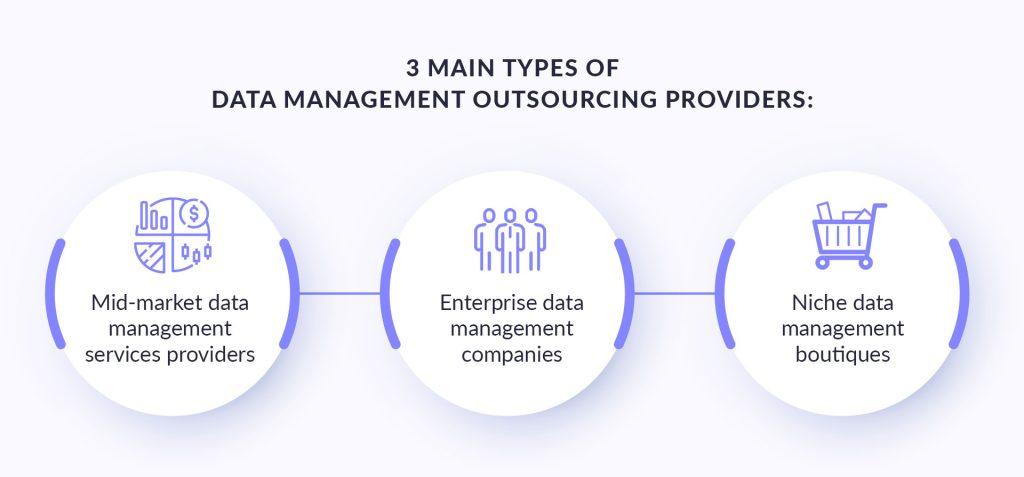
- Data management outsourcing vendors fall into three categories: enterprise data management companies, mid-market data management services providers, and niche data management boutiques.
- Mid-market data management companies offer the best balance for cloud modernization, combining delivery speed with moderate governance limitations.
- The best mid-market data management services providers are Geniusee, Slalom, and Ciclum. Enterprise system integrators are suited to large, multi-year enterprise programs, combining strong governance with high cost and lock-in trade-offs.
- The best enterprise system integrators are Accenture, IBM Consulting, and Capgemini.
- Niche data management boutiques address narrowly scoped, high-specialization needs where deep expertise outweighs scale and continuity risks.
- The best niche data management boutiques are Syniti, Talend Services, and Stibo Systems.
Scope: This guide is for teams choosing an external partner to design, build, and/or run an enterprise data workstream on a modern platform (data platform setup, pipelines, governance, quality, analytics enablement). It does not cover general software development agencies.
What do we mean by data management outsourcing?
Data management outsourcing means delegating design, implementation, and/or the ongoing operation of your data stack to an external provider, typically covering data platform setup, ingestion and pipelines (ETL/ELT), data quality controls, governance, and MDM support, and, when needed, long-term operations under SLAs.
How we built this shortlist: methodology and evaluation criteria
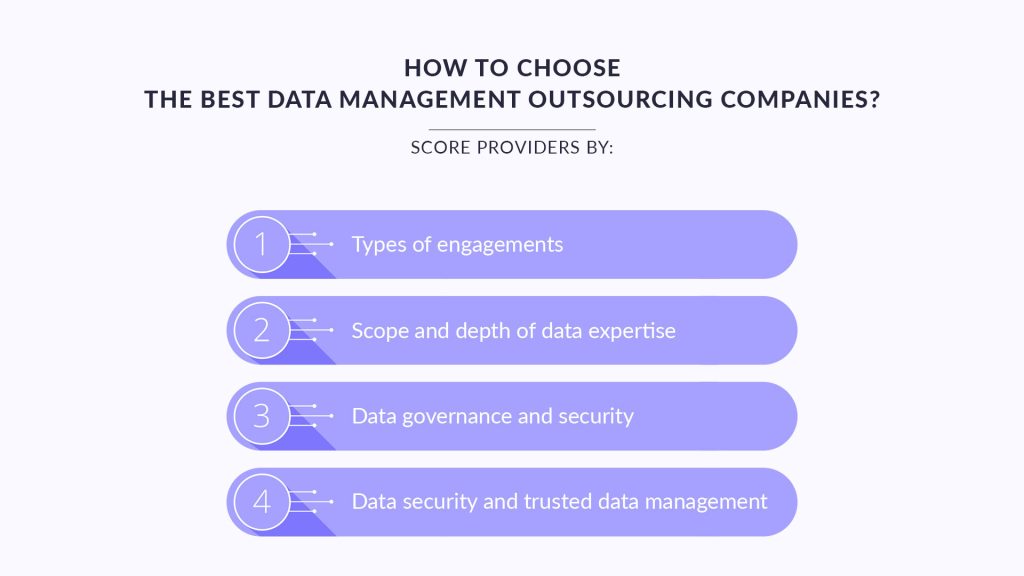
We grouped providers by delivery model and compared them using only publicly verifiable signals: published client case studies, publicly stated certifications, and official partner or marketplace listings.
We defined what counts as data management outsourcing (managed services, staff augmentation, or consulting), and then selected companies that met these criteria:
- Scope and depth of data expertise
- Data governance and security
- Data security and trusted data management
We aimed to publish a real shortlist of companies you can choose from, rather than a generic list of random agencies.
| Authority references. When we mention security and compliance signals, we refer to the underlying primary standards and frameworks, such as ISO and IEC standards for ISMS and privacy controls (for example, ISO/IEC 27001) and SOC 2 reporting based on the AICPA Trust Services Criteria. |
What are the main types of data management outsourcing providers?
Data management outsourcing providers fall into three distinct categories. We advise you to choose the category first before comparing specific companies.
Mid-market data management services providers
They focus on modernizing data platforms, migrating legacy ETL to the cloud, and building automated workflows across common stacks (AWS, Azure, dbt, Snowflake, Power BI).
Best for mid-sized organizations doing data platform modernization, cloud migration, and workflow automation.
Trade-offs: lighter enterprise governance and documentation rigor, limited ability to scale instantly to very large, multi-time-zone teams, and a tendency toward preferred “default stacks.”
Enterprise data management companies
They excel at handling complexity and scale, with robust governance and global delivery networks.
Best for large enterprises running multi-year transformation programs or complex multi-vendor orchestration, especially when modernizing multiple legacy systems.
Trade-offs: high overhead, rigid scope (often waterfall or hybrid Agile), and vendor lock-in via bundled licensed software and long-term commitments.
Niche data management boutiques
These agencies prioritize specialization over scale, offering deep expertise in areas like MDM, data quality, specific platforms, and industry compliance. Many are led by former enterprise architects.
Best for MDM initiatives, regulated environments, or projects tied to a specific vendor ecosystem. Strong choice when data governance requirements dominate.
Trade-offs: limited bandwidth due to small teams; narrower end-to-end coverage, and higher key-person risk if senior specialists rotate off.
Top trusted data management outsourcing companies by category (shortlist)
Below is the table of the top data management companies. It maps each vendor to its provider category, primary focus, and best-fit scenario so you can narrow options fast before deeper validation.
| The company | Market category | Primary focus | Best for |
| Geniusee | Mid-market data management companies | Modern tech stacks (AWS, Snowflake, Databricks, DBT, Power BI), data engineering, and analytics enablement. | Organizations that need a strategic partner that can handle complex end-to-end data management projects for mature businesses. |
| Slalom | Mid-market data management companies | Data strategy and modernization on platforms like Snowflake, Databricks, and AWS. | For enterprises that desire to build scalable, real-time analytics platforms or seek to modernize their data architecture. |
| Ciklum | Mid-market data management companies | Scalable data engineering and analytics delivery on major cloud platforms. | Digital-first and product-led organizations that need fast, iterative delivery of cloud data pipelines and analytics (batch + streaming). |
| The company | Market category | Primary focus | Best for |
| Accenture | Enterprise data management companies | Building and operating enterprise-wide data platforms, governance frameworks, and analytics systems at scale. | Large enterprises need robust, scalable data infrastructure and have the resources for lengthy implementation cycles. |
| IBM Consulting | Enterprise data management companies | Hybrid data architectures, legacy-to-cloud modernization, and AI-driven analytics. | Large enterprises looking to modernize legacy systems and implement intelligent data architectures. |
| Capgemini | Enterprise data management companies | Building and operating enterprise data platforms and managed analytics programs. | Capgemini’s strength lies in its ability to deliver end-to-end solutions, from strategy to implementation and ongoing management. |
| The company | Market category | Primary focus | Best for |
| Syniti | Niche data management boutiques | Master data management, data governance, and data quality solutions. | Organizations with complex MDM needs or stringent data governance requirements. |
| Talend Services | Niche data management boutiques | Data integration, data quality, and open-source data management tools. | Organizations with complex ETL needs or those that require strong data quality controls as part of a broader data management strategy. |
| Stibo Systems | Niche data management boutiques | Master Data Management (MDM) for product, customer, and supplier data. | Organizations that rely heavily on product data and need a robust solution to manage and optimize their master data across channels. |
Mid-market data management companies
1. Geniusee
Geniusee stands out when you need to combine senior-level data engineering expertise and fast delivery. They excel in modern tech stacks such as Snowflake, Databricks, DBT, and Power BI, bringing results with a strong focus on data management, reliability, and cost-effectiveness. Geniusee covers the entire product lifecycle with ISO-certified quality while emphasizing a client-first approach and strong IP protection.
- Primary focus. Building modern cloud data platforms, data engineering, custom AWS development, and business analytics enablement.
- Best fit clients. Mid-market companies seeking fast, high-quality execution with manageable overhead.
- Typical engagements. Architecting secure and scalable data infrastructure, designing and implementing ETL/ELT pipelines, AWS/DevOps, and business analytics platforms.
- Delivery model. Onshore-style governance and communication, supported by nearshore engineers with significant time overlap.
Objective signals:
- ISO 27001 certificate, ISO 9001 certificate
- AWS Advanced Tier status
- Сase study: Data pipeline solutions for robotics and IoT
With boutique-level speed and enterprise-grade security, Geniusee is an excellent fit for organizations that need a strategic partner that can handle complex end-to-end data management projects for mature businesses.
2. Slalom
Slalom is a good choice for mid-market teams focused on business transformation. They are known for building scalable, real-time analytics platforms with a strong focus on business outcomes.
- Primary focus. Data strategy and modernization on platforms like Snowflake, Databricks, and AWS.
- Best fit clients. Upper mid-market teams modernizing analytics infrastructure.
- Typical engagements. Cloud migration, analytics platform buildouts, and business intelligence enablement.
- Delivery model. Predominantly onshore delivery with a regional team structure.
Objective signals:
- Strong partner ecosystem
- Security commitment
- Сase study: RMIT University data and analytics platform
Slalom is well-suited for organizations seeking to modernize their data architecture and accelerate their analytics capabilities.
3. Ciklum
Ciklum is a great fit for digital-first organizations that need fast, iterative delivery of cloud data pipelines and analytics.
- Primary focus. Scalable data engineering and analytics delivery on major cloud platforms: AWS, Azure, and Google Cloud.
- Best fit clients. Digital-first and product-led organizations that need fast, iterative delivery of cloud data pipelines and analytics.
- Typical engagements. Building or modernizing lakehouse/warehouse foundations, implementing batch + streaming pipelines.
- Delivery model. Nearshore delivery with U.S. presence for project management and solution design.
Objective signals:
- ISO/IEC 27001:2013, ISO/IEC 27701:2019 certifications
- Strong partner ecosystem
- Сase study: automated ETL for fintech client
Ciklum combines the scalability of a large vendor with the agility of a boutique, making it a strong fit for digital-first organizations that need to move fast.
Enterprise top data management companies
1. Accenture
Accenture is best for large enterprises running complex, multi-year data programs that require strong governance and enterprise-scale delivery.
- Primary focus. Building and operating enterprise-wide data platforms, governance frameworks, and analytics systems at scale.
- Best fit clients. Fortune 500, regulated industries, and globally distributed enterprises.
- Typical engagements. Multi-year digital transformation programs, data platform implementation, and managed analytics.
- Delivery model. Global delivery with strong onshore presence.
Objective signals:
- Recognized leader for data and analytics service
- Security awards and certifications
- Сase study: a data governance automation solution
Accenture’s data management expertise is best suited for large enterprises needing robust, scalable data infrastructure and have the time and budget for lengthy corporate procurement and implementation cycles.
2. IBM Consulting
IBM Consulting is best for large enterprises with complex legacy estates and hybrid cloud requirements. They help enterprises transform their business, leveraging IBM infrastructure and partnerships with AWS, Azure, and Google Cloud.
- Primary focus. Hybrid data architectures, legacy-to-cloud modernization, and AI-driven analytics.
- Best fit clients. Large enterprises with complex existing data estates and mainframe dependency.
- Typical engagements. Data architecture design, governance framework implementation, and legacy system modernization.
- Delivery model. Global delivery with onshore solution teams and a partner ecosystem.
Objective signals:
- ISO 27017:2015, SOC, and other compliance certificates
- Security commitments
- Сase study: Siemens and Red Hat collaboration.
IBM is best suited for large enterprises looking to modernize legacy systems and implement intelligent data architectures.
3. Capgemini
Capgemini is a go-to option for large enterprises that need end-to-end delivery across strategy, implementation, and ongoing managed analytics support.
- Primary focus. Building and operating enterprise data platforms and managed analytics programs.
- Best fit clients. Large enterprises with distributed structures and diverse data environments.
- Typical engagements. Data operating model design, platform migration, and long-term analytics support.
- Delivery model. Global delivery with leadership based onshore.
Objective proof signals:
- Strong partner ecosystem
- Security commitment
- Сase study: cloud solutions for WindTre.
Capgemini’s strength lies in its ability to deliver end-to-end solutions, from strategy to implementation and ongoing management.
Niche data management boutiques
1. Syniti ( formerly BackOffice Associates)
Syniti is best for organizations with complex MDM, governance, and data quality programs where the information layer is the main risk.
- Primary focus. Master data management, data governance, and data quality solutions.
- Best fit clients. Enterprises with complex MDM needs or strict data governance requirements.
- Typical engagements. Implementing governance frameworks, cleansing, and harmonizing master data.
- Delivery model. Global delivery with a strong track record of onshore-based projects.
Objective proof signals:
- ISO/IEC 27001 certification
- AWS Partner Network listing
- Сase study: global pharmaceutical SAP migration
Syniti is best suited for organizations with complex MDM needs or stringent data governance requirements.
2. Talend Services
Talend Services is best for organizations where data quality and integration are the primary constraints, supported by Talend’s platform and implementation expertise.
- Primary focus. Data integration, data quality, and open-source data management tools.
- Best fit clients. Organizations with complex ETL needs or strict data quality requirements.
- Typical engagements. Implementing data quality rules, real-time data integration, and supporting MDM.
- Delivery model. Global delivery with professional services and a partner ecosystem.
Objective proof signals:
- Strong partner ecosystem
- ISO/IEC 27001:2013, ISO/IEC 27701:2019 certificates
- Сase study: data solutions for the Institute of Technology
Talend is best suited for organizations with complex ETL needs or those that require strong data quality controls.
3. Stibo Systems
Stibo Systems is best for organizations that need an enterprise Master Data Management (MDM) platform for product, customer, or supplier data across multiple channels.
- Primary focus. Master Data Management (MDM) for product, customer, and supplier data.
- Best fit clients. Retailers, manufacturers, and CPG companies needing robust product data management.
- Typical engagements. Implementing MDM platforms, data governance, and product information management.
- Delivery model. Global delivery with a strong presence onshore.
Objective proof signals:
Stibo Systems is best suited for organizations that rely heavily on product data and need a robust solution to manage and optimize their master data across channels.
How to use this shortlist to choose a vendor?
Consult this shortlist to choose a data management services provider for your data management projects, then run a short scoping call to outsource data management services, including comprehensive data management services.
If you need practical help aligning the service scope to your requirements or want to review proposals with our data experts, get in touch.
How do you choose the right data management outsourcing company?
Start by selecting the right provider type; screen vendors on objective evidence, validate delivery mechanics, and finally run a time-boxed paid discovery/pilot with concrete deliverables to test execution rather than presentations.
What is data management outsourcing?
It is delegating part (or all) of the design, build, and/or operation of your data stack to an external provider. Common scope: data platform setup, ingestion and pipelines (ETL/ELT), data quality controls, governance support, MDM, observability, and ongoing platform operations under SLAs.
How much does data management outsourcing cost in the U.S.?
In the U.S., the charge is typically quoted as an hourly rate. U.S. onshore consulting is commonly $100-$250/hour. Nearshore engineering teams are often priced roughly $40-$75/hour (role-dependent). Offshore senior engineering rates are commonly $25-$60/hour (with Latin America/Eastern Europe often higher than South/Southeast Asia).
Is offshore data management outsourcing safe?
It can be safe if you implement strong controls. Require contractual safeguards for cross-border processing where relevant, demand auditability (e.g., SOC 2 Type II report access and/or ISO 27001 certification in scope), enforce least-privilege access, MFA, environment segregation, encryption, secrets management, logging/monitoring, and strict data egress controls. Align responsibilities using the cloud shared-responsibility model rather than assuming the vendor or cloud provider “covers security.”
How long does a typical engagement last?
A typical cadence is two to six weeks for discovery, roughly 6-16 weeks for a bounded platform-and-pipelines build, 3-12 months for broader modernization or legacy migrations, and 6-24 months for managed operations.
When should we not outsource data management?
Avoid outsourcing when you cannot assign an internal owner to set priorities and accept deliverables, when requirements are so undefined that the vendor would be forced to make strategy decisions, when the work is core differentiating IP and you cannot share domain context, or when you lack the ability to govern the work through security reviews, architecture sign-off, and change control.