Generative AI is radically transforming DevOps into intelligent, creative collaboration. The technology is a force multiplier, enabling teams to navigate complexity and achieve accuracy like never before.
Generative AI is also transforming DevOps, as teams can now create entire services and infrastructure from natural language input. AI now auto-generates and optimizes activities that used to take hours. Let’s take, for example, building cloud infrastructure or configuring CI/CD pipelines. Besides deployment, GenAI can identify and resolve infrastructure issues, as well as optimize cloud usage by resizing instances and consolidating resources.
In UI/UX, prompts can be transformed into a complete website with tools like Lovable, making DevOps processes more dynamic, context-dependent, and automated.
What is the importance of such a shift? The conventional automation is strong yet limited. It operates according to a set of instructions. In contrast, gen AI can come up with several directions to reach a goal. It is the beginning of a new age when AI agents become active partners.
Key takeaways
- Generative AI is a smart assistant that can supplement human intelligence by automating complicated cognitive processes.
- It enables the design, optimization, and explanation of infrastructure, as well as incident management.
- Adoption requires a model of human-in-the-loop, where AI-generated outputs are always reviewed by the developers.
- It is crucial to proactively solve issues such as model hallucination and security to establish trust.
What is Generative AI in DevOps?
It generates original code, configurations, or text using patterns that it has learned through enormous datasets. In DevOps, it is more than just script or documentation generation. It also detects and troubleshoots failures and simplifies infrastructure. GenAI may also be used to examine trends in deployment and resource utilization to suggest more effective configurations, identify bottlenecks, and recommend cost-reduction measures.
What is its essential difference from traditional automation?
The traditional automation of DevOps is deterministic. It is a strict logical “if-this-then-that” logic. It is trustworthy, but its scope is limited. Generative AI, on the other hand, is creative and probabilistic. You can also frame it with a new issue, and it will produce a logical diagnosis and practical suggestions. It is no longer an implement executing but a partner who thinks.
What are the essential capabilities for software development teams?
Generative AI has three revolutionary capabilities:
- Translation: It transforms high-level requirements expressed in natural language to concrete technical products.
- Explanation: It demystifies complicated systems by providing clear answers to complex code or log files.
- Synthesis: It integrates information from different sources to synthesize a consistent diagnosis or holistic solution.
How does Generative AI transform the DevOps lifecycle?
Generative AI adds an intelligent element to each stage of the ongoing delivery loop, resulting in a more dynamic and responsive workflow.
Smart application and anticipatory tracking
The deployment stage is no longer a mechanical process, but a strategic one. Generative AI can learn the app characteristics and previous data to create the most effective rollout strategies. The change in monitoring is related to reactive alerting to predictive insight.
Rather than just stating that the CPU is 95% utilized by the database, the AI may provide context:
- The CPU spike is associated with a particular, inefficient query.
- The query is listed below, along with a recommended index.
Constant feedback and comprehensive optimization
This is where Generative AI becomes a more tactical and strategic asset. It constantly evaluates the end-to-end DevOps pipeline and finds those bottlenecks that are not always evident. To illustrate, a Ukrainian founder used GPT to review AWS RDS usage and found a misconfigured, expensive instance. They saved $4,000 per month on their RDS bill by switching to ARM-based Graviton2 instances from AWS, which had no performance impact.
It can prescribe instance resizing, delete orphaned resources, and deploy direct business savings from technical data.
Capability comparison
| Activity | Traditional DevOps approach | AI-augmented DevOps approach |
| Infrastructure provisioning | Manual writing or copying/modifying existing IaC scripts. | Generating bespoke, compliant IaC templates from a natural language description. |
| Incident response | Developers consult runbooks and rely on experience to diagnose issues. | The real-time incident analysis identifies the probable root cause and generates a customized mitigation runbook. |
| Cost optimization | Periodic manual audits require significant effort and expertise. | Continuous, automated cloud spend analysis with actionable, context-aware recommendations. |
Benefits of integrating Generative AI
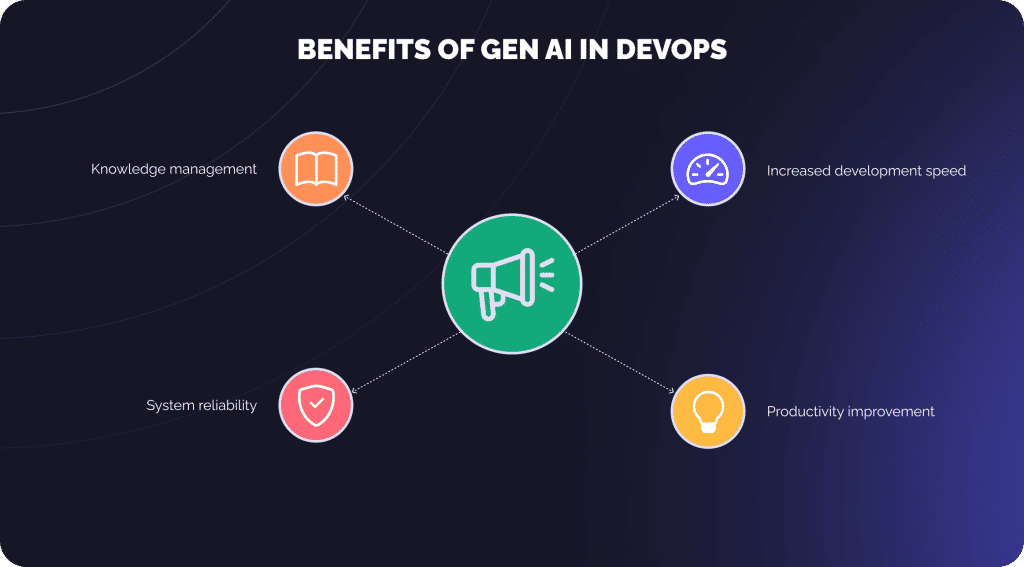
Generative AI integration leads to tangible changes in several key performance indicators:
- Increased speed of development: AI significantly reduces the required time to develop by generating boilerplate code, unit tests, and configuration files.
- Productivity improvement: Automation reduces manual tasks, such as document writing and manual alert triage. This allows devs to focus on creative projects that can directly drive business objectives.
- Improved system reliability and resilience: Generative AI enhances system strength by generating more intelligent test cases and edge cases that humans can easily overlook.
- Better knowledge management and collaboration: AI serves as an expert on demand. It ensures institutional knowledge is documented and readily available, and eliminates information silos.
Practical use cases in action
Theoretical advantages of Generative AI are strong, but its true value lies in how it is applied in practice.
Generation of dynamic infrastructure as code (IaC)
The description of a desired state can be provided in simple English: “Provide a private, highly available Kubernetes cluster on Azure with three node pools. Then, gen AI will generate a set of well-structured Terraform or Bicep files, based on best security practices.
Active pipeline optimization of CI/CD
AI can compare the results of the pipeline performance. It identifies flaky tests, detects resource contention issues, and recommends the most effective caching strategy. It can even generate the configuration code to make these optimizations, radically reducing the time spent by developers on feedback.
For example, DataRobot introduced an AI-based CI/CD optimizer that analyzes historical build and test data to determine which test to run first. This reduces build time because the most critical or those with a high failure probability are run first, while stable tests are deprioritised. The outcome: reduced response times and fewer and shorter misused compute times.
GenAI also enables CI/CD self-tuning, making the pipeline more reliable and freeing developers from the task of manually debugging their pipeline.
High-end log analysis and anomaly correlation
Generative AI is also very good at interpreting chaos. In case of a system failure, it generates dozens of logs across microservices. Subsequently, it links events in these sources to create a concise and chronological incident history, noting the cause and its circumstantial consequences.
Challenges and risks
Although the potential is enormous, it requires a careful adoption strategy to reduce the underlying risks.
Accuracy and hallucination
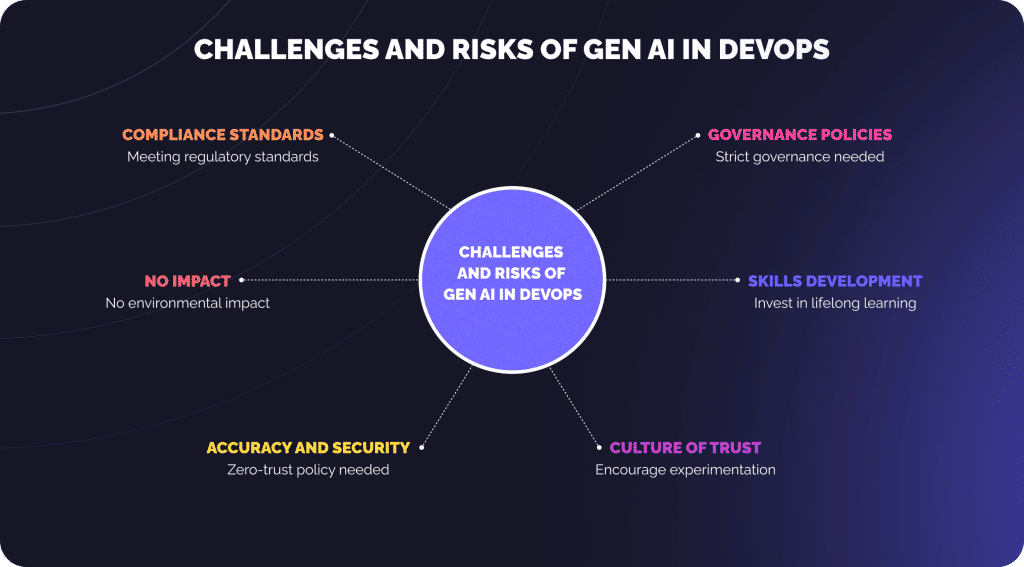
Generative AI models sometimes produce believable but false results. This risk necessitates a zero-trust policy. Every AI-generated representation should be thoroughly tested and reviewed by humans before being promoted to production.
Key steps include:
- Enacting the mandatory code review gates for all AI-generated scripts.
- Conducting entire security and unit tests on AI-recommended code.
- Viewing AI as a junior dev who has to be supervised by seniors.
Security and compliance
New attack surfaces are introduced by AI-generated code. Companies need to determine strict governance policies. This includes:
- The AI-generated code scan by security tools.
- Keeping AI interaction audit trails.
- Meeting data sovereignty and regulatory standards.
Culture and integration
The latest AI tool cannot help as long as the teams do not trust it. Implementing a new AI co-pilot requires change management. Enforce team training on how to do practical prompt engineering. As a leader, you should encourage a culture of experimentation and learning.
Invest in lifelong learning and skills development
Help your teams become AI-effective. Develop technical skills (prompt engineering) and strategic skills (critical evaluation).
Best practices of a successful adoption roadmap
The key to the advantages of Generative AI in the least disruptive manner is a phased approach.
- Begin with a pilot project: To start with, a low-risk, high-value use case. The most ideal starting points are:
- Automated documentation generation.
- Writing new functionality tests.
- Non-critical deployment scripts: optimization.
- Implement the human-in-the-loop mode: Put in place so that the AI output is not just a product. Install checkpoints in processes.
- Establish an effective governance system by implementing strict policies, including privacy and security scanning, authorized applications, and robust data protection measures.
Conclusion
DevOps is currently facing a powerful reality of generative AI. The fact that it can automate cognitive labor and simplify complexity represents a paradigm shift. The future is a synergistic relationship, where the creative power of AI enables the management of scale and leverages human experience in strategy and innovation.
Ready to integrate an AI co-pilot into your DevOps processes and get enhanced efficiency and innovation? Collaborate with Geniusee to devise a custom generative AI approach to change your software delivery lifecycle.
Let’s build the future together. Contact our experts for a consultation!
What are the priority tasks in the automation of DevOps teams for Generative AI?
Begin with those areas that have the most significant delays, that is, documentation, pipeline debugging, or routine infrastructure changes. The tasks deliver quick wins and help teams build confidence before introducing AI into more complex operations.
Does Generative AI need significant modifications to the current DevOps tooling?
The vast majority of current platforms offer APIs or plugins, enabling teams to adopt GenAI over time. The largest change is in the workflow, not in the tooling. Devs will need to learn how to integrate AI recommendations into their everyday lives.
What do companies need to do to make sure that GenAI does not create security risks?
Set scanning and reviewing gates on all AI-generated outputs. Add audit logs and access controls to ensure that each model interaction can be traced and conforms to internal standards.
Which skills are the most valuable to DevOps engineers in GenAI?
Prompt engineering helps developers communicate with AI systems with intent, whereas critical evaluation ensures safe and reliable output. A combination of these skills will transform developers into AI overseers.