
To achieve sustainable AI investment returns and deployment maturity, Geniusee recommends a systematic, inside-out transformation rather than fragmented pilots.
Core strategic pillars:
- Governance first: Appoint a Chief AI Officer (CAIO) to own the roadmap and break down silos.
- Distributed intelligence: Avoid isolating AI within IT; embed experts directly into departments (Marketing, HR, Finance).
- Inside-out implementation: Optimize internal high-volume manual tasks before launching customer-facing tools.
- Data & talent readiness: Address the #1 blockers (the talent gap (36%) and data silos (30%) through role-specific upskilling.
Target ROI: Aim for 40–60% time savings on core operational tasks by automating data-rich processes and repetitive workflows.
While 92 percent of companies plan to increase their artificial intelligence investments over the next 3 years, only 1% of leaders call their companies “mature” in deployment. That gap tells the story.
Indeed. Many business leaders I spoke with have the same fears: if, in the long term, AI is promising, the short-term returns are vague and risky.
So the real question for every business leader is this: how do we put capital to work and guide our organizations toward being truly AI-first? Where does that transformation begin? It starts with a comprehensive AI implementation strategy tailored to your specific infrastructure.
In this article, you can explore the step-by-step actions for a successful AI strategy. At Geniusee, we follow this exact AI implementation framework internally, and the results have been transformative for our own business processes.
So why do you need an AI implementation strategy?
Becoming an AI-first enterprise goes beyond just applying random AI-powered tech elements to your product. It’s about the AI transformation of your team’s work. That means widespread adoption of AI agents in daily routines, or to scan for the best supplier offers. Your marketing team may use Perplexity to run daily competitor analysis. Or what about using Deep Research for your R&D processes to surface the latest scientific breakthroughs in hours, not weeks?
Done right, in addition to cost efficiency, AI reduces operational time and enables work that was impossible before.
Let’s go back to the early days of the cloud. At first, it was seen as a technical upgrade. Now it’s about scalability and a new way of serving clients. Today, AI is the same principle but a more holistic one. It belongs not to the feature shift, but to how the whole business runs. So long story short: think globally, clean your existing data, and build the basics first so people and agents can collaborate in day-to-day workflows.
The biggest barrier to AI integration is leadership uncertainty
They need to do something with AI, but don’t understand how to build that strategy.
To successfully implement AI, leaders must align their AI adoption plans with core business goals. Without a solid data strategy and high data quality, even the most advanced AI system will fail to deliver business value.
47% of the C-suite say their companies develop gen AI tools too slowly, even though 69% started investing more than a year ago. McKinsey’s numbers resonate with what I see: employees are ready to experiment. But without a plan, it can turn into failure. Therefore, leadership has to set direction, make adoption systematic, and decide areas where AI can bring real value: from choosing the right pain points to policy elaboration.
Our recent survey at Geniusee on AI adoption, involving over 1,000 business leaders, confirms this. It shows that a lack of AI talent and poor data quality are among the widespread reasons companies fail to adopt AI effectively.
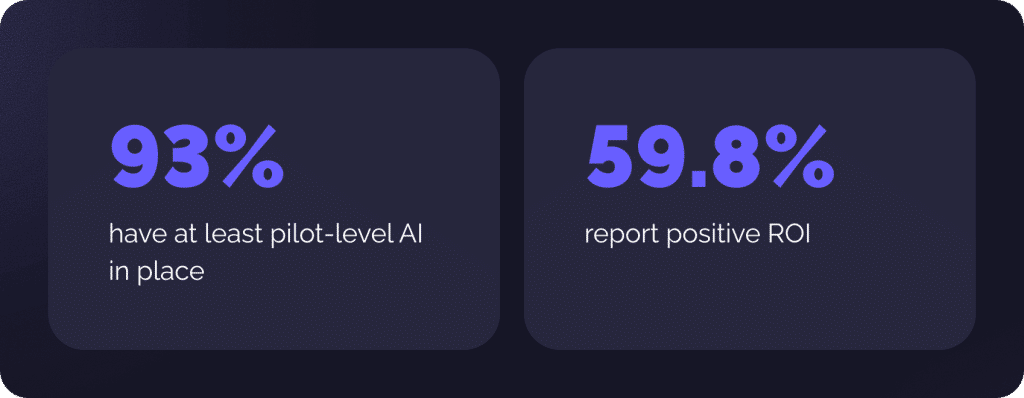
While 93% have at least pilot-level AI in place and 59.8% report positive ROI, we found something revealing: 21.3% have no workforce strategy for AI adoption yet. They’re moving forward without a clear plan. And 29.6% cite talent gap as their top blocker, while another 24.9% struggle with data issues. These aren’t tech problems. They’re systematic execution ones.
And that leaves leaders asking me the same questions again and again:
- Which processes should we prioritize: those to monetize or those to automate?
- How to design an integrated strategy that reduces fear, builds trust, and gets people using bots, agents, and AI tools with confidence?
My answer is to create a holistic, company-wide roadmap inside-out (NOT just automating a single manual-heavy process here and there), triggering transformation across every department simultaneously.
Successful AI implementation: From fragmented pilots to enterprise-wide transformation
Too many companies identify manual-heavy processes and automate them in isolation. It’s like a band-aid solution. At Geniusee, we do it the following way:
Set up clear governance (or nothing will stick)
The primary pain point for leaders I spoke with was managing multiple disconnected initiatives when implementing AI. Instead, I suggest starting with structuring the roles and functions:
- Appoint a Chief AI Officer or equivalent. This person owns the unified, well-crafted AI strategy, decides which investments get funded, ensures ethical and compliant use, breaks down silos between tech and business, and builds a culture where people actually want to use AI.
- Build a cross-functional AI task force. Include department heads from delivery and non-delivery teams (marketing, customer success, operations, HR, finance, + AI specialists). This ensures AI solves real business problems instead of just impressive demos.
Distribute, don’t centralize
Instead of building a massive central AI office and asking everyone to come to it for answers, the most progressive organizations embed AI thinking directly across all teams and disciplines. One of the best real-world examples isn’t even from private industry, but higher education.
At the Times Higher Education Global AI Summit, Hans van Oostrom detailed how the University of Florida rebuilt itself around AI, not by putting it in its own silo, but by distributing it everywhere. Thanks to a transformative partnership with NVIDIA, UF chose not to form a single Department of AI. Instead, they hired over 100 AI-focused faculty members and placed them across 16 colleges (including medicine, agriculture, journalism, and more), making every part of the university responsible for its own AI integration. Every instructor got hands-on AI training, and each discipline was empowered to experiment, build, and share what worked.
Result: AI didn’t become an add-on or afterthought. It became part of the DNA of every program, from agriculture to the arts. Interdisciplinarity became the cultural foundation, and innovation scaled from the ground up rather than top down.
Map your processes at the department level
To integrate AI into your business, you must first create an AI roadmap. Identify areas where AI can deliver the most business value. AI helps most in data-rich environments where AI tools can automate high-volume manual work.
- Most companies have no clear picture of what their teams do day-to-day. Before implementing AI, you need to document the following actions:
- Map end-to-end workflows for each department.
- Identify decision points, data flows, and manual bottlenecks.
- Document where time gets wasted.
- Catalog your data sources (where they live, how clean it is).
Note: Use AI to map your processes. AI-powered tools analyze system logs and user behavior to show you what people actually do vs. what they say they do. That gap is where your most significant opportunities hide.
- Prioritize using clear success criteria:
- High-volume, repetitive tasks consuming significant time
- Data-rich processes where AI extracts insights
- Manual decision-making that could benefit from predictive analytics
- Quality control and compliance requiring consistency
- Customer-facing operations where personalization adds value
- Create R&D capacity to evaluate opportunities systematically
Building robust AI solutions requires dedicated intelligence specialists who understand AI capabilities. They should test how AI agents can orchestrate complex workflows.
Don’t just hand this to your existing IT team. Staff dedicated roles:
- AI engineers and data scientists for technical feasibility
- Business analysts for ROI assessment
- Domain experts who understand your industry
- Ethics and compliance specialists to spot risks
Give them a methodology: review processes across all departments systematically, analyze data availability and quality, assess integration requirements, evaluate AI maturity for specific tasks, and estimate realistic resource needs.
The companies getting this right embed AI specialists directly into business functions, not isolated in IT. That’s how you get solutions people actually use.
- Build education programs that transform how people work
The biggest barrier isn’t technology. It’s people who don’t understand AI, fear it, or don’t see how it helps them.
Based on the survey, here’s what I see in practice: 54.4% of companies are actively upskilling their workforce, while 21.3% have no strategy yet. That 21.3% figure should concern you. They’re deploying AI without preparing people for it, which explains why the talent gap remains the #1 adoption barrier across the industry.
Create role-specific training. For example, executives need AI strategic implications and governance frameworks, not technical details. Department heads need AI applications tailored to their specific functions and change management strategies. Managers — practical AI tool usage and how to coach struggling employees. Don’t forget about employees. Teach them AI literacy fundamentals, prompt engineering, and critical evaluation skills.
Implement in phases with metrics that matter
Stop doing scattered pilots. Roll out systematically:
| Phase | Timeline | Focus area | Goal |
| 1. Align AI with existing infrastructure | 1-3 Months | Strategy and data readiness | Define success metrics |
| 2. Launch the first AI project with clear metrics | 3-6 Months | 3-5 internal strategic pilots | Document ROI |
| 3. Integrate AI into core tech stacks | 6-18 Months | Platform infrastructure | Reusable AI components |
| 4. Embed AI into business logic | Ongoing | All business processes | Shift to advisory model |
- Phase 1 (1-3 months). Assess AI readiness across strategy, data, technology, talent, and governance. Establish baseline metrics and define success criteria.
- Phase 2 (3-6 months). Launch 3-5 strategic pilots with clear success criteria. Start internal—optimize your processes before customer-facing applications. Focus on high-volume manual work. Document what works and the actual ROI.
- Phase 3 (6-18 months). Build platform infrastructure for rapid deployment. Standardize workflows with built-in governance. Expand successful pilots. Create reusable components.
- Phase 4 (ongoing). Embed AI into all business processes. Shift the CoE to advisory. Establish continuous improvement. Keep innovating.
Following our experience at Geniusee, I can assume that the following criteria are worth taking into account:
- Business impact: revenue lift, cost reduction (target 40-60% time savings), customer satisfaction
- Adoption: percentage actively using AI (target 80%+), departments with production systems
- Efficiency: automation rates, time savings (target 4 hours per employee weekly)
- Governance: adherence to frameworks, audit success, security metrics
Trigger systematic change across all departments
Each function needs a tailored approach with coordinated timing:
- Delivery teams: development workflows, automation of code review and testing.
- Marketing: AI content generation, automated competitor analysis, predictive optimization.
- Customer success: AI chatbots, sentiment analysis, churn prediction.
- HR: AI recruitment, personalized learning, workforce planning.
- Finance & operations: Automated reporting, forecasting, supply chain optimization.
Address the real blockers head-on
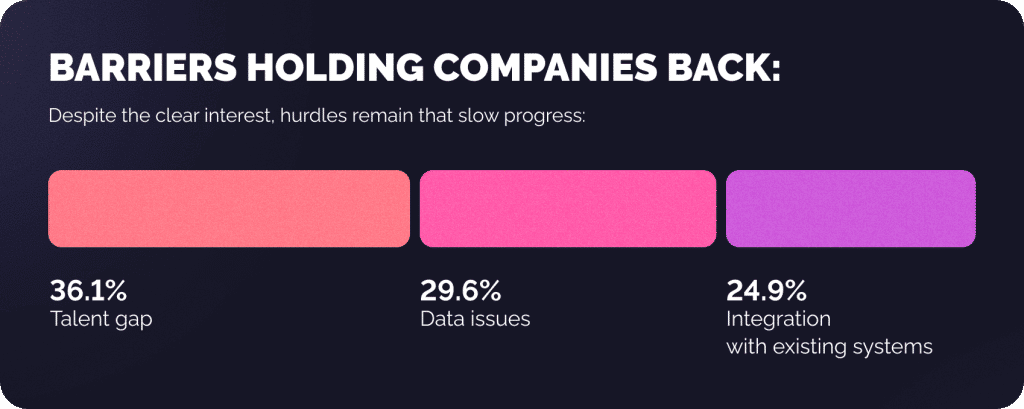
Our survey revealed three critical barriers holding companies back:
- Talent gap (36.1%) is the top blocker. Demand for AI expertise far exceeds supply.
- Data issues (29.6%) in terms of quality, availability, and silos.
- Integration with existing systems (24.9%). Companies haven’t prepared their tech stack. This is why layered infrastructure works (not monoliths). And this is where modernizing your legacy architecture becomes the prerequisite for AI success.
Only 1.2% of companies report negative ROI. My verdict is that the risk is lower than the fear suggests. But success requires systematic execution, not just investment.
Wrap up
AI is about interactions and connections inside the company processes and between people.
Customer-facing AI shouldn’t be your first move since it can backfire. Start from internal processes and optimisation of existing projects. Your #1 priority is high-volume manual work and data-rich processes that can be significantly simplified and streamlined. Do not rush to scale your product. Start small: save time for your employees and structure data before it becomes the source of pulling insights across millions of documents.
I have one good AI use case, an example with one of our clients, Imagine AI. When we partnered with their team, we didn’t launch with a public chatbot. We centralized workflows and deployed AI agents to handle routine recruiter tasks: parsing and tailoring CVs, running “search everything” across large datasets, and drafting client-ready summaries. The results were significant: up to 85% time saved on core tasks and 80–90% faster candidate search. That’s what I’m trying to highlight: “start inside”, free people from repetitive work, structure the data, and let agents orchestrate the steps end-to-end so humans can focus on judgment and relationships.
Explore the full success story: How Geniusee helped Forsyth Barnes accelerate the hiring process by up to 90%
If you need a comprehensive guide to making your company AI-first and a concise framework for moving forward, schedule a call with our AI specialists or check out our AI workshop.