AI is moving from experimentation to everyday infrastructure, becoming the backbone of how companies operate and innovate. As 2026 approaches, AI is rapidly advancing across various sectors. A recent study reveals that 92% of technology leaders utilize AI-assisted coding tools in their work, and 78% of developers employ them daily.
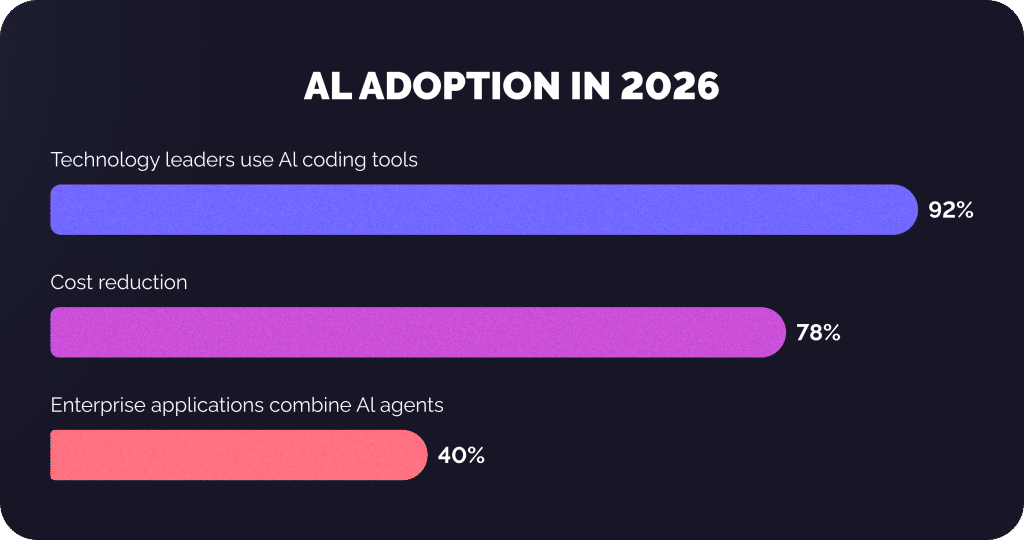
And here’s the most interesting part from our study: 93% of businesses have already started pilot AI projects. Yet most companies are stuck in “pilot purgatory”: they have fragmented tools, outdated data pipelines, and unclear governance. Just a quarter of them have formalized AI rules. This not only slows adoption but also underscores the scale of the potential for smarter, more organized strategies.
Businesses are now asking, “How do we turn AI into real workflows, ROI, and transformation?” instead of introducing new tools. This transition is why semi-autonomous AI agents and AI-based development tools are becoming a priority in 2026. Companies are adopting AI to reduce manual effort, enhance decision-making, and eliminate operational bottlenecks.
Key takeaways
- AI is accelerating software development and improving code quality.
- Semi-autonomous AI agents are simplifying decision-making across sectors.
- Ethics and regulatory standards are changing to keep up with the developments of AI.
№1: AI in software development trends
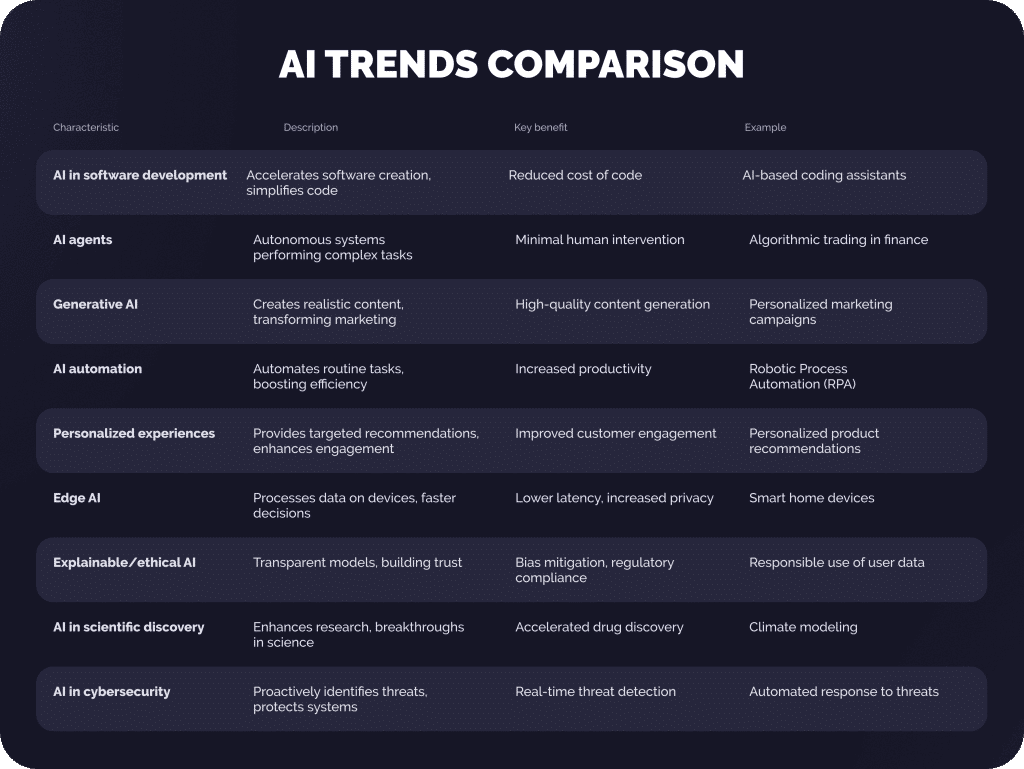
AI-powered systems and machine learning are turning over a new leaf in software development, simplifying and reducing costs. Our team already widely uses apps such as Cursor. It demonstrates that AI-driven engineering is rapidly becoming the new standard.
In practice, modern AI agents do not just code fragments; they index your entire repository. This allows a developer to query, “What effect will modifying the old billing module have on this API endpoint?” and receive an architectural analysis within seconds.
- AI-based coding assistants: Tools such as GitHub Copilot, Tabnine, and Cursor help write code fragments, complete functions, and even make real-time bug fixes. According to ScienceDirect, LLMs aren’t limited to a specific input format or structure, offering high flexibility and reducing developers’ cognitive burden.
- Automation testing and deployment: AIs can automatically create and perform test cases. Amazon Q Developer (previously CodeWhisperer) and Amazon Nova reduce QA cycles. This requires significantly less time and effort compared to manual testing and deployment.
- Low-code platforms: Low-code platforms, such as n8n, Mendix, and OutSystems, enable app development by both non-coders and coders. This allows teams to prototype and deliver internal tools much more quickly.
Example applications
- Automation in DevOps: AI tools are automating processes that can deliver software at an accelerated and more extensive rate.
- Adaptive software design: AI responds to needs and changing environments, thereby enhancing the user experience and satisfaction.
№2: AI agents
Autonomous AI systems, including agentic AI, are becoming an integral part of many industries, performing complex tasks with minimal human intervention.
What are AI agents?
The most significant change in 2026 will be the transition of chat to action. We are entering an era of autonomous AI agent systems that do not simply wait to be prompted to act but instead formulate and execute multi-step operations.
Compared to a passive chatbot, an AI Agent has access to tools (APIs, CRMs, ERPs) and memory. Real-life situation: consider a supply chain agent. Rather than manually reviewing invoices, the agent checks an inbox, retrieves the PDF information, verifies it against the ERP system, and notifies a human only when a mismatch exceeds $500.
Use сases
- Finance: AI applications can be used for algorithmic trading, risk evaluation, and fraud detection, which are quicker and more efficient than manual methods.
- Customer support: AI agents can remotely assist customers 24/7 via virtual assistants and chatbots.
- Enterprise operations: AI agents also take on workflow management, scheduling meetings, and administrative tasks.
Emerging platforms
- Blender with MCP: Incorporating AI agents into programs such as Blender with multi-channel processing can provide more advanced and efficient content generation workflows.
- Incremental development agents: Systems enable the creation and implementation of AI agents across different sectors.
№3: Generative AI evolution
Gen AI models are continually evolving, including large language models and multimodal AI, with the latest and most advanced AI capabilities. They create highly realistic images, transforming industries such as marketing, entertainment, and design.
There is a real danger of the generic “AI slop” as the “Synthetic Flood” risk, with 90% of online content estimated to be synthetic by 2026. AI is very efficient at quantity but inefficient at subtlety. Competitive advantage will no longer be about content generation but about authenticity, ensuring that human expertise cuts through automated data noise.
As a countermeasure, we will expect to see the implementation of standards such as C2PA (Coalition for Content Provenance and Authenticity) to sign content cryptographically. Companies will have to demonstrate to their clients that their reports and insights are not the result of subjective biases or hallucinations.
№4: AI automation in workflows
Automation is getting “smart.” We are shifting away from Intelligent Document Processing (IDP) toward hard Robotic Process Automation (RPA). Beyond basic scripts: When a website button is moved, Traditional RPA will fail. AI automation involves computer vision and semantic understanding to evolve.
- Smart processing: AI can read, classify, and transform unstructured, messy data (such as handwritten forms) with virtually human-like accuracy into their corresponding database records.
- The workforce shift: With AI agents replacing regular administrative tasks, the labor market will polarize. Businesses will eliminate the legacy operational positions to reduce costs and recruit high-value specialists like AI integration architects to manage these autonomous systems.
The Jevons paradox: the hardware crunch
Leaders need to consider the Jevons Paradox in 2026: as AI becomes cost-effective, the need to compute grows exponentially, and the cost scales unexpectedly high, creating a bottleneck.
A colossal RAM shortage is coming in 2026. Because manufacturers such as Samsung and SK Hynix have tried to shift production to AI-specific High-Bandwidth Memory (HBM), conventional DDR5 stock has decreased.
- The reality: The DDR5 16Gb chip has increased in price by nearly 300% since late 2025, costing no less than $27.20, compared to an earlier price of about $6.84.
- The effect: Companies that want to cut labor costs are losing those savings in infrastructure expenditures. The objective is not merely to deploy AI in 2026, but to make the most of it to survive this hardware inflation.
№5: AI in personalized experiences
Personalization is becoming more hyper-specific and real-time, moving beyond the simple “people who bought this also bought that model.”
- The clinical standard: There is no better place to start than in healthcare. 2026 will be the year AI goes beyond experimental trials and into standard clinical practice. We are witnessing the digitalization of old hardware, like AI-enhanced stethoscopes, which introduce diagnostic logic into routine patient care.
- Education: Adaptive platforms are no longer just quizzes, but real-time tutors that can adjust the curriculum to match a student’s level of frustration or interest, as gauged through interactional patterns.
№6: Edge AI expansion
Not every task requires a vast, costly model like GPT-5. Edge AI and Small Language Models are the pragmatic trends in Edge AI for 2026.
Why smaller is better: Running data locally on a device (Edge) will achieve lower latency and increased privacy.
- Privacy & GDPR: Financial and healthcare companies are switching to on-premise SLMs. This enables sensitive data to be handled on a local server or even on a user’s laptop without making any API calls to the cloud.
- IoT & automotive: A spotty cloud connection will not suffice in self-driving cars. Edge AI enables cars and industrial sensors to make decisions locally in seconds, saving bandwidth and making them safer.
№7: Explainable and ethical AI
With AI in production, Trust, Risk, and Security Management (AI TRiSM) will be on the agenda. AI can no longer just provide an answer; it must also give a reason.
- Developing trust: Explainable AI (XAI) provides the rationale behind a decision, a requirement for loan approvals and medical diagnoses.
- Green computing (GreenOps): It is projected that 12% of US electricity will be used in data centers. Therefore, in 2026, this is a major priority. We will observe AI automating its infrastructure- keeping cooling loops in check and load balancing software, in addition to a strategic movement to new sources of power such as Small Modular Reactors.
№8: AI in scientific discovery
AI is serving as an R&D multiplier. We are leaving the trial and error to simulation and prediction.
Collaborative intelligence
- In Drug Discovery, AI applications are used to analyze life science data to identify potential drug candidates, which can take months to years of preliminary research.
- In Materials Science, deep learning models can predict the behavior of new alloys before they are actually created. It’s not merely automation but rather an enhancement of human creativity through open research programs and data exchange.
№9: AI-enhanced cybersecurity
AI-powered systems are also transforming cybersecurity. As attackers employ AI for advanced phishing attacks, defenders must counter these attacks with AI.
The era of defensive AI:
- Predictive defense: AI-generated algorithms analyze network traffic baselines to identify anomalous traffic patterns that a human analyst might miss.
- Automated response: Intelligent systems can now automatically isolate an infected device to prevent the spread of a breach.
- The problem: Security vs. privacy is always a thin line. To safeguard user data, organizations need to employ Privacy-Enhancing Technologies (PETs) and develop effective security models.
What will AI do to change software development in 2026?
AI will automate coding, testing, and debugging, making the development process both faster and more reliable. The developers will pay more attention to architecture and problem-solving.
What is the difference between a Chatbot and an AI Agent?
A chatbot responds to questions based on its training data. A self-directed system, an AI Agent can utilize tools, perform tasks in multiple steps (such as sending emails or searching databases), and make decisions, operating within established guardrails.
Will AI replace developers?
No. AI is still involved in routine tasks, though human judgment and engineering expertise remain necessary. Human-AI collaboration is the most effective.
Which sector of industry will be most affected by AI in the year 2026?
The biggest beneficiaries are finance, healthcare, logistics, and software engineering. Automation and advanced models enable faster operations, greater accuracy, and lower costs.